
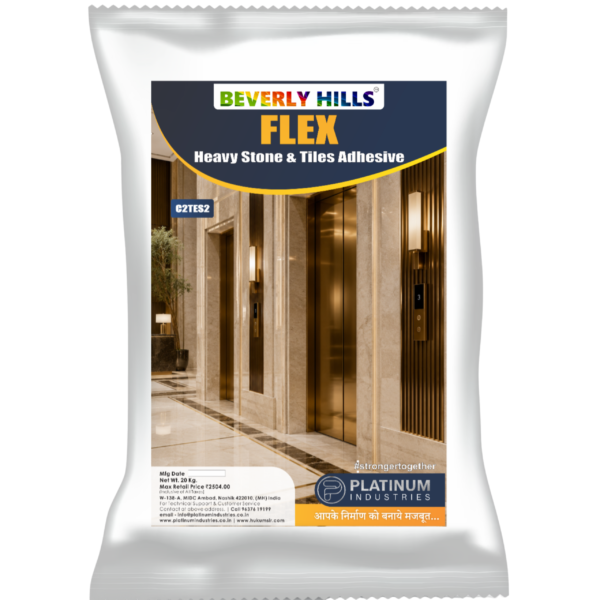

T5 – FLEX HIGH FLEXIBILITY TILE ADHESIVE
EN 12004 Classification: C2TES2
At a Glance
| Feature | Details |
| Ideal For | Flexible & Critical Substrates |
| Maximum Tile Size | Large Format Tiles & Porcelain Slabs* |
| Tile Types | Porcelain, Vitrified, Marble, Granite & Natural Stone |
| Suitable Surfaces | Plywood, Gypsum Board, Fibre Cement Board, AAC Blocks, Concrete & Existing Tiles |
| Wall Height | High-Rise Interior & Exterior Applications* |
| Floor Applications | Residential, Commercial & Industrial |
| Interior | ✔ Yes |
| Exterior | ✔ Yes |
| EN Classification | C2TES2 |
| Bond Strength | Superior High Performance |
| Flexibility | S2 Highly Deformable |
| Ready Mix | Just Add Water |
*Subject to substrate condition, installation method, and project-specific engineering requirements.
Product Selection Guide
Choose Flex High Flexibility Tile Adhesive when:
- Installing tiles on flexible substrates such as plywood, gypsum board, fibre cement board, or cement boards.
- Fixing large porcelain slabs, vitrified tiles, natural stone, or engineered stone.
- Working on high-rise buildings, façades, terraces, balconies, or vibration-prone areas.
- The project demands the highest level of flexibility and long-term performance from a cementitious adhesive.
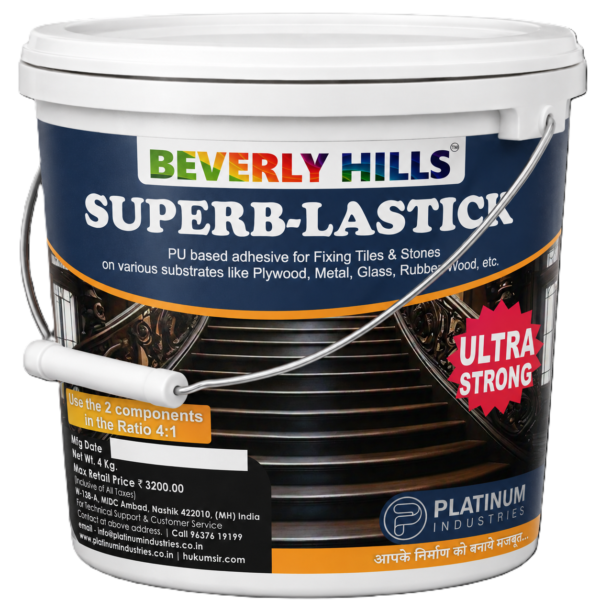
For swimming pools, fountains, water tanks, spas, and permanently submerged installations, choose T7 Marine. For bonding dissimilar materials such as metal, wood, glass, PVC, or aluminium, use SuperbLastick PU Adhesive.
Maximum Flexibility for the Most Demanding Installations
Beverly Hills Flex is an ultra-premium, high-polymer cementitious tile adhesive specially formulated for installations where movement, vibration, thermal expansion, or substrate flexibility can cause conventional adhesives to fail.
Designed for difficult substrates and demanding environments, Flex delivers exceptional bond strength, superior deformability (S2), extended open time, and outstanding resistance to thermal and structural movement. It is the preferred solution for premium architectural projects, high-rise buildings, lightweight wall systems, and installations where long-term performance is critical.
Best Suited For
Residential Applications
- Luxury Villas
- Premium Apartments
- Large Format Living Room Flooring
- Designer Bathrooms
- Imported Tile Installations
- Modular Kitchens
- Terrace Decks
- Rooftop Areas
- Balconies
- Feature Walls
Commercial & Institutional Applications
- Shopping Malls
- Airports
- Hotels
- Corporate Offices
- Hospitals
- Educational Campuses
- IT Parks
- Metro Stations
- Commercial Façades
- High-End Retail Stores
Suitable Tile Types
✔ Porcelain Slabs
✔ Large Format Porcelain Tiles
✔ Large Vitrified Tiles
✔ Full Body Vitrified Tiles
✔ Granite
✔ Marble
✔ Engineered Stone
✔ Natural Stone
✔ Quartz Stone
Suitable Substrates
Specifically engineered for difficult and flexible substrates including:
- Plywood
- Gypsum Board
- Fibre Cement Board
- Cement Board
- AAC Blocks
- Concrete
- RCC
- Cement Plaster
- Existing Ceramic Tiles
- Existing Vitrified Tiles
- Heated Floor Systems (where specified)
Where This Product Excels
Flex is the preferred choice where the installation is exposed to:
- Thermal Expansion
- Structural Movement
- Vibration
- Lightweight Construction Systems
- High-Rise Buildings
- Exterior Façades
- Large Tile Installations
- Premium Architectural Finishes
Why Choose Flex?
- Highest flexibility in the Beverly Hills cementitious adhesive range.
- S2 deformability absorbs structural and thermal movement.
- Exceptional bond strength for demanding installations.
- Excellent adhesion on difficult and low-absorption substrates.
- Extended open time for easier placement of large-format tiles.
- Reduced slip for vertical applications.
- Suitable for interior and exterior use.
- Ideal for lightweight wall systems and modern construction methods.
- Long-lasting performance in high-stress environments.
Understanding EN 12004 – C2TES2
C = Cementitious Tile Adhesive
2 = Improved Adhesion Strength
T = Reduced Slip
E = Extended Open Time
S2 = Highly Deformable Adhesive capable of accommodating significant structural movement, vibration, and thermal expansion without losing bond integrity.
C2TES2 represents one of the highest performance classifications for cementitious tile adhesives and is intended for the most demanding tile installation applications.
Technical Specifications
| Property | Typical Value |
| EN Classification | C2TES2 |
| Colour | Grey |
| Base Material | High Polymer Modified Cementitious Adhesive |
| Mixing Water | 24–26% |
| Pot Life | 3–4 Hours |
| Open Time | ≥30 Minutes |
| Adjustment Time | 30 Minutes |
| Slip | ≤0.5 mm |
| Tensile Adhesion (Dry) | ≥2.0 MPa |
| Tensile Adhesion After Water Immersion | ≥1.5 MPa |
| Tensile Adhesion After Heat Ageing | ≥1.5 MPa |
| Tensile Adhesion After Freeze-Thaw | ≥1.5 MPa |
| Deformability | ≥5 mm (S2) |
| Service Temperature | -30°C to +90°C |
| Foot Traffic | After 24 Hours |
| Grouting | 24 Hours (Walls), 24–48 Hours (Floors) |
| Full Cure | 14 Days |
| Packaging | 20 kg Bag |
| Shelf Life | 12 Months |
Approximate Coverage
| Notched Trowel | Coverage (20 kg Bag) |
| 10 × 10 mm | 28–35 sq.ft. |
| 12 × 12 mm | 22–28 sq.ft. |
| 15 × 15 mm | 16–22 sq.ft. |
Coverage depends on tile size, substrate condition, and application thickness.
Mixing Instructions
- Add 5.0–5.2 litres of clean water per 20 kg bag.
- Mix with a slow-speed mechanical mixer until smooth and homogeneous.
- Allow the mixture to stand for 3–5 minutes, then remix before use.
- Do not add extra water after the adhesive begins to set.
Application Procedure
Step 1 – Surface Preparation
Ensure the substrate is clean, dry, structurally sound, and free from dust, grease, paint, curing compounds, or loose particles. Flexible substrates must be securely fixed and adequately supported.
Step 2 – Mixing
Prepare the adhesive to a smooth, lump-free consistency using the recommended water ratio.
Step 3 – Adhesive Application
Spread the adhesive with a suitable notched trowel.
Back-buttering is strongly recommended for large-format tiles and natural stone to achieve maximum adhesive contact.
Step 4 – Tile Installation
Position the tile carefully using a sliding motion while maintaining consistent joint spacing. Use levelling clips for large-format installations.
Step 5 – Finishing
Allow the adhesive to cure completely before grouting or placing the installation into service.
Best Practices
✓ Always back-butter large-format tiles and slabs.
✓ Ensure nearly full adhesive coverage, especially in exterior and heavy-duty applications.
✓ Use movement joints as recommended by industry standards.
✓ Verify substrate stability before installation.
✓ Use appropriate levelling systems for large-format tiles.
Avoid These Mistakes
✗ Installing on unstable or poorly fixed substrates.
✗ Ignoring movement joints.
✗ Adding cement, sand, or extra water to the adhesive.
✗ Walking on freshly installed tiles before adequate curing.
✗ Using the wrong trowel notch for large-format tiles.
💡 Pro Tip
Flexible substrates expand, contract, and move more than conventional concrete surfaces. Using a highly deformable S2 adhesive helps absorb these movements, reducing the risk of tile debonding, cracking, or grout failure over time.

Reviews
There are no reviews yet.